I think that the purpose of this lab was to see in internal anatomy to see how the systems and anatomy that we learned about in this unit look in real life. The pig's internal anatomy is essentially the same as a human's so during the dissection we could see all the organs that we learned about, and it really helped visualize how the systems actually look like in our bodies. We were able spend time looking at each system My favorite part of the dissection was seeing the difference between the abdominal and thoracic cavities. In the abdominal cavity, all of the organs looked very interesting and unique, and in the thoracic I was especially fascinated by how the lungs looked. The organs in each cavity were very different and it was interesting to see the contrast. I thought that this dissection was a very valuable experience. It was a way for me to actually appreciate what's inside of my own body, and it was an experience that I won't get very often. Although I have done many dissections in the past, I look forward to doing a lot more in the future.
I was not able to embed the videos, but here are the links:
Video Tutorial: https://www.youtube.com/watch?v=8lWrsM2a2Ls&list=UU4c9SscfUCFA1NHkgEAr8zg&index=1
A fun vlog we made on the first day of the dissection: https://www.youtube.com/watch?v=aW1REKnDW6E&index=2&list=UU4c9SscfUCFA1NHkgEAr8zg
Wednesday, May 31, 2017

Monday, May 22, 2017
20 Time Reflection
For my 20 time project, I worked with Monica, and we went vegetarian and vegan for a month. I did this because I wanted to see how different diets would affect my body, and to also test my discipline. I was also aware of the health benefits of these diets and I was also concerned about the amount of animals being tortured and killed for food. I was focused on self-improvement and acknowledging where our food comes from.
Our initial plan was to go pescatarian for a week, vegetarian for a week, and then vegan for the last week. We decided that one week was not enough time to see the effects of the diets, so we cut out the pescatarian part and extended vegetarian and vegan for two weeks each.
I personally though that it went really well. It was very difficult to keep my discipline and avoid the foods that I wasn't supposed to eat, but I was able to do it. We were also able to regularly update our blog, and I was able to measure both of our blood pressures and heart rates every other day.
I learned how to come up and coordinate an organized schedule with my partner. My time management with projects is usually not exceptional with projects, but this time we worked efficiently and got done quick. The only exception was with the video, which we started a bit late, so it was slightly rushed. If I had the chance to do this project again, I would have extended the amount of time we did the diets for, so that way I could really test the extent of my discipline. I learned that I have a lot of self control when I am focused and willing.
In the future I may try this again, specifically for a longer period of time, but I want to encourage other people to try it, as if one person cuts meat out of their diet, it won't make a huge difference on the amount of animals getting slaughtered, but if a lot of people do, there is a chance for change.
Our initial plan was to go pescatarian for a week, vegetarian for a week, and then vegan for the last week. We decided that one week was not enough time to see the effects of the diets, so we cut out the pescatarian part and extended vegetarian and vegan for two weeks each.
I personally though that it went really well. It was very difficult to keep my discipline and avoid the foods that I wasn't supposed to eat, but I was able to do it. We were also able to regularly update our blog, and I was able to measure both of our blood pressures and heart rates every other day.
I learned how to come up and coordinate an organized schedule with my partner. My time management with projects is usually not exceptional with projects, but this time we worked efficiently and got done quick. The only exception was with the video, which we started a bit late, so it was slightly rushed. If I had the chance to do this project again, I would have extended the amount of time we did the diets for, so that way I could really test the extent of my discipline. I learned that I have a lot of self control when I am focused and willing.
In the future I may try this again, specifically for a longer period of time, but I want to encourage other people to try it, as if one person cuts meat out of their diet, it won't make a huge difference on the amount of animals getting slaughtered, but if a lot of people do, there is a chance for change.
Wednesday, May 10, 2017
Unit 9 Reflection
This unit was about taxonomy and classification. We learned how different organisms are classified through the system: Domain, kingdom, phylum, class, order, family, genus, species. After learning about history of taxonomy, we went into details about kingdoms within the three domain, especially bacteria and eukarya. After learning about each domain, we learned about a lot of phyla within each domain and kingdom, especially within eukarya and animalia. Throughout this unit we saw how evolution plays a big part in relationships between different phyla and classes. I would still like to learn about archaea, as we have not really talked about that domain.
This unit we did a "What on Earth Evolved Presentation". Overall I learned a lot from not only doing my presentation, but also from watching my classmates' presentations. I did my presentation on the extinct organism, the trilobite. I think my presentation went pretty well, but the one thing I would have changed is how prepared I was. I was planning on having my presentation memorized, but I did not end up having enough time to practice a lot, so I would have allowed myself more time to do that. During this project, I learned that practice is very important, no matter how confident you are.
In my unit 8 reflection, I stated how I want to be more assertive. I think that I have been doing a better job doing that in spite of the fact that that there was not too much time for group collaboration during this unit.
 |
| Picture of different organisms |
This unit we did a "What on Earth Evolved Presentation". Overall I learned a lot from not only doing my presentation, but also from watching my classmates' presentations. I did my presentation on the extinct organism, the trilobite. I think my presentation went pretty well, but the one thing I would have changed is how prepared I was. I was planning on having my presentation memorized, but I did not end up having enough time to practice a lot, so I would have allowed myself more time to do that. During this project, I learned that practice is very important, no matter how confident you are.
 |
| https://commons.wikimedia.org/wiki/File:Taxonomic_Rank_Graph.svg |
In my unit 8 reflection, I stated how I want to be more assertive. I think that I have been doing a better job doing that in spite of the fact that that there was not too much time for group collaboration during this unit.
Thursday, April 20, 2017
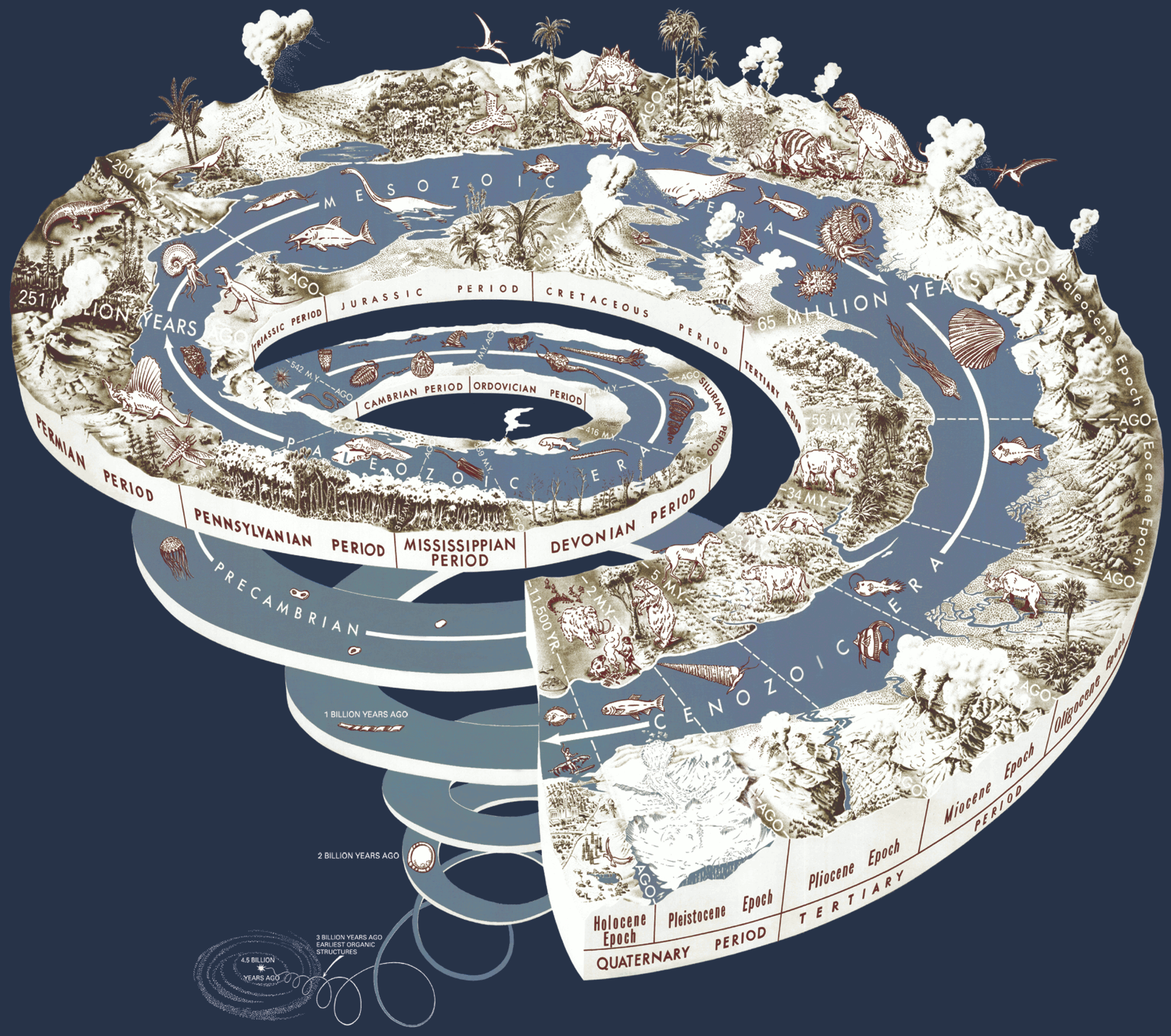
Geologic Timeline
Three very important events in earth's history were the first prokaryotes, the Cambrian explosion, and the Permian-Triassic Extinction. Prokaryotes were the first life forms on earth, so I believe that the creation of the first prokaryotes was extremely significant, as they paved the way for life on earth. If they have never been created, life on earth may not exist now or be as diverse as it is. The Cambrian explosion was radiation of a lot of species, and when a lot of complex fossils began to appear. This event was very a very important evolutionary event, and may have paved they way for many species we have now. Although the Permian-Triassic extinction was the largest mass extinction in history, it paved the way for a lot of new species. These species include dinosaurs, which are a very unique and valued part of earth's history.
Earth was formed about 4.6 billion years ago, but it was just fire and no life. The simplest life appeared about 4 billion years ago and complex life forms only began to become more common about 542 million years ago. I was surprised by how large the amount of time was that we had no life or only prokaryotic cells. More complex life and life that we are more familiar with only showed up towards the end of the scale.
Monday, April 10, 2017
Unit 8 Reflection
This unit was all about constant change. We learned that population are always evolving and there are many different factors that can cause this. Darwin was a very important scientist, who made significant conclusions about natural selection. He also discovered that natural selection is the cause of evolution. The hunger games lab was a very hands on lab that was able to help illustrate the concept of natural selection. We learned about the different pieces of evidence for evolution, like fossils and homologous structures, and how there are other factors and selection that can lead to evolution, such as genetic drift and directional selection. Lastly, we looked at the big picture by learning about earth's timeline and how earth formed, which gave us a scale on which all the previous topics have happened.


In the future, I would like to learn more about the evolution of different specific species. I especially want to learn more about the evolution of the human species, and the evolution of human populations in the area where I live, or in different countries. I wonder what species and populations have been evolving in the area where I live, as there is a lot of different animals that live near me.
In order to be assertive, I have been trying to reinforce in my head what it is that I really want or want to ask for. I need to work on my confidence when asking or saying something, as I am sometimes scared that I might offend someone or my words may be taken the wrong way.
Monday, April 3, 2017
Hunger Games Final Analysis
1. In this lab, we divided the class into three different variants of a species and competed for food and survival. This lab simulated how natural selection can cause evolution in a population.
2. The "Pincher" phenotype was the best at capturing food because it was quickest to pick up the corks with two fingers compared to between your wrists and knuckles. That is the the most natural way for us to pick up objects, which is why it was more effective than the other two phenotypes.
3. In this lab we asked the question: Do populations evolve? I found that the population did evolve, as both the allele frequency and amount of each phenotype has changed. All the phenotypes started with 10 individuals, but by the end there was only 1 stumpy, 14 knucklers, and 6 pinchers. The frequency of the "A" allele has decreased while the "a" allele has increased. This is because the pinchers (aa) have been able to reproduce significantly more than the stumpies (AA), resulting in the "a" becoming more common.
4. The flipping of the coins to simulate sex was random, and the distribution of the food was random, except for when it was in one big pile. Our mates were not random, as we got to choose who to mate with. The non random mating could affect the population, as if you mate with someone with the same genotype as you, your offspring may be more likely to look like the parents. When the food was all in one pile, there was more competition, whereas when it was randomly distributed, everyone was in their own space.
5. If the food had been larger, the population would look more like the stumpies, as it is easier to pick up big pieces of food between the wrists, but the knucklers would not have thrived because it is very difficult to pick up large objects between the knuckles. If the food had been smaller, the population would look more like the pinchers, as it is easy to pick up small objects with your fingers, however there would be few stumpies.
6. If there were no imcomplete dominance there would be no knucklers as they are the result of the heterozygous genotype. Although the genotype for a pincher is homozygous recessive, I believe that pinchers would become more common as they are significantly more efficient at picking up food than the stumpies.
7. Natural selection is a cause of evolution. Over time natural selection can lead to a change in allele frequency in a population, which is considered evolution.
8. Some individuals were more aggressive than other individuals. In real life, this resembles competition and the fight to survive. I even saw some individuals use their phenotype improperly. For example, I saw some stumpies using their hands to scoop up food as well. This can lead to an inaccurate measurement of allele frequency.
9. In evolution, populations evolve due to natural selection. Natural selection acts on phenotypes rather than gentoypes, because factors in the environment only are exposed to the physical traits of the individuals rather than their genes.
10. I wonder how natural selection has affected populations in the area where I live. Has there been a lot of evolution recently?

2. The "Pincher" phenotype was the best at capturing food because it was quickest to pick up the corks with two fingers compared to between your wrists and knuckles. That is the the most natural way for us to pick up objects, which is why it was more effective than the other two phenotypes.
3. In this lab we asked the question: Do populations evolve? I found that the population did evolve, as both the allele frequency and amount of each phenotype has changed. All the phenotypes started with 10 individuals, but by the end there was only 1 stumpy, 14 knucklers, and 6 pinchers. The frequency of the "A" allele has decreased while the "a" allele has increased. This is because the pinchers (aa) have been able to reproduce significantly more than the stumpies (AA), resulting in the "a" becoming more common.
4. The flipping of the coins to simulate sex was random, and the distribution of the food was random, except for when it was in one big pile. Our mates were not random, as we got to choose who to mate with. The non random mating could affect the population, as if you mate with someone with the same genotype as you, your offspring may be more likely to look like the parents. When the food was all in one pile, there was more competition, whereas when it was randomly distributed, everyone was in their own space.
5. If the food had been larger, the population would look more like the stumpies, as it is easier to pick up big pieces of food between the wrists, but the knucklers would not have thrived because it is very difficult to pick up large objects between the knuckles. If the food had been smaller, the population would look more like the pinchers, as it is easy to pick up small objects with your fingers, however there would be few stumpies.
6. If there were no imcomplete dominance there would be no knucklers as they are the result of the heterozygous genotype. Although the genotype for a pincher is homozygous recessive, I believe that pinchers would become more common as they are significantly more efficient at picking up food than the stumpies.
7. Natural selection is a cause of evolution. Over time natural selection can lead to a change in allele frequency in a population, which is considered evolution.
8. Some individuals were more aggressive than other individuals. In real life, this resembles competition and the fight to survive. I even saw some individuals use their phenotype improperly. For example, I saw some stumpies using their hands to scoop up food as well. This can lead to an inaccurate measurement of allele frequency.
9. In evolution, populations evolve due to natural selection. Natural selection acts on phenotypes rather than gentoypes, because factors in the environment only are exposed to the physical traits of the individuals rather than their genes.
10. I wonder how natural selection has affected populations in the area where I live. Has there been a lot of evolution recently?
Thursday, March 9, 2017
Unit 7 Reflection
This unit was all about ecology and conservation biology. We learned about the different components of an ecosystem, like abiotic and biotic factors. We also learning about different factors that affect how much and ecosytem can hold, like carrying capacity and population density. Perhaps most importantly, we learned about healthy ecosystems, and ways we can keep them healthy. Healthy ecosystems have high biodiversity, and how people can protect ecosystems by methods like protecting biodiversity hot spots and restoration. I learned that humans are causing a lot of harm and are pushing a lot of species towards extinction because we are getting rid of their habitats and are contributing to climate change, which can be very harmful to many different species.

After watching the movie Bag It!, which showed the negative effects of using plastic, I started wondering what other activities or goods do I use on a daily basis that could potentially be harmful to the environment. If we keep consuming at the rate that we are in the US, how long will all the natural resources last before we start to get limited?

Overall, the Conservation Biologist project went very well. All of the members of my group contributed, which usually does not end up happening when I do group project. We managed to finish our research and make the slide presentation quickly, and fairly effortlessly. The only problem we had was that we first recorded our presentation in separate videos, but after realizing it was not possible to edit them together, we had to rerecord it in one take. In my New Years Goals blog post, I mentioned how I wanted to get as much work done in school as possible so I would not have to worry at home. That was true of this project, as I only had to spend about 10 minutes at home. Through this project I also learned that there is an enormous variety of threats to different ecosystems, some of which you would not expect to be a threat.
According to the self assessment we took, my highest total was for assertive, so I would like to keep this up in the future. I just need to work on being able to ask for help more easily.
After watching the movie Bag It!, which showed the negative effects of using plastic, I started wondering what other activities or goods do I use on a daily basis that could potentially be harmful to the environment. If we keep consuming at the rate that we are in the US, how long will all the natural resources last before we start to get limited?

Overall, the Conservation Biologist project went very well. All of the members of my group contributed, which usually does not end up happening when I do group project. We managed to finish our research and make the slide presentation quickly, and fairly effortlessly. The only problem we had was that we first recorded our presentation in separate videos, but after realizing it was not possible to edit them together, we had to rerecord it in one take. In my New Years Goals blog post, I mentioned how I wanted to get as much work done in school as possible so I would not have to worry at home. That was true of this project, as I only had to spend about 10 minutes at home. Through this project I also learned that there is an enormous variety of threats to different ecosystems, some of which you would not expect to be a threat.
According to the self assessment we took, my highest total was for assertive, so I would like to keep this up in the future. I just need to work on being able to ask for help more easily.
Subscribe to:
Posts (Atom)